The Mechanics of Rust Jacking and Fixing Cracked Concrete Around Railing Posts
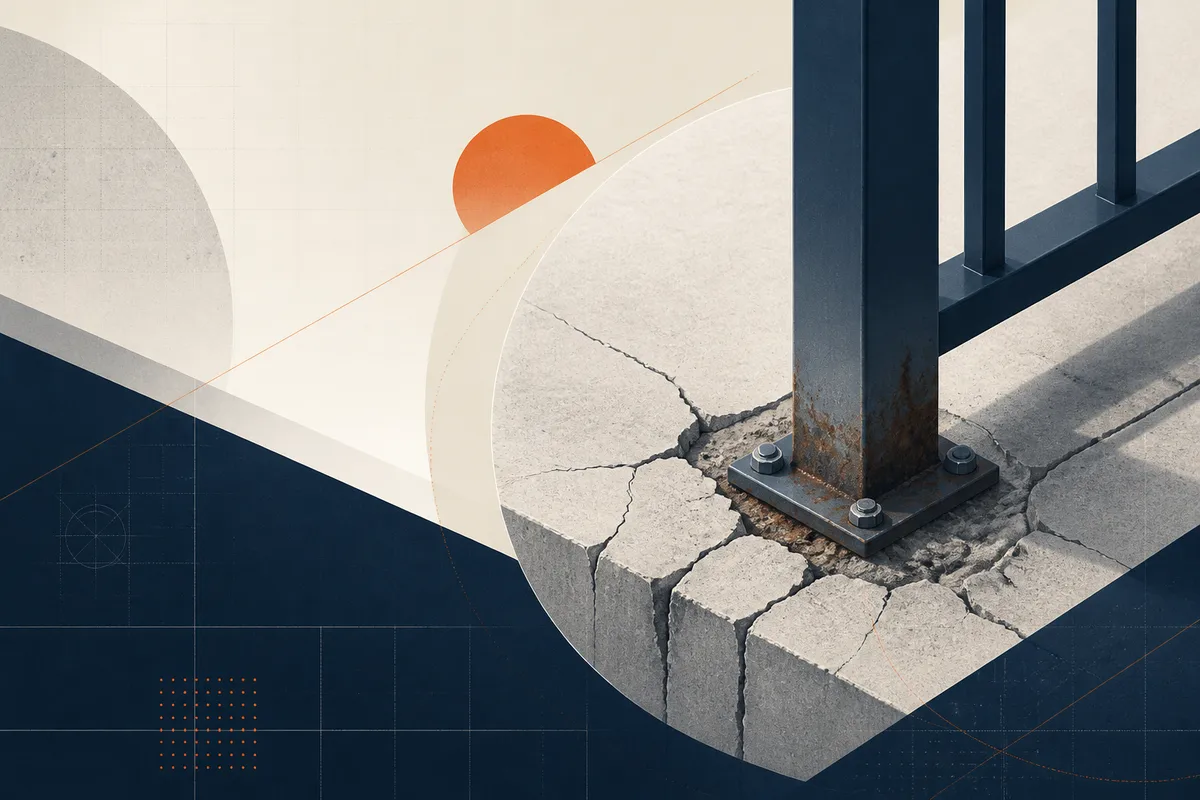
Most property owners in Detroit mistake a "blowout" at the base of their porch railing for a simple concrete age issue. They apply a layer of store-bought patch material, only to find the crack returning larger and more jagged the following spring. The reality is that the concrete isn't failing on its own; it is being pushed apart by the very post it is meant to support.
This guide details the phenomenon of rust jacking and the industrial-grade process for fixing cracked concrete around railing posts. It is written for property managers and homeowners who need to transition from repetitive, failed patches to a permanent structural solution.
Why Railing Foundations Fail in the Great Lakes Climate
In regions like Southeast Michigan, the combination of road salt, heavy precipitation, and extreme temperature swings creates a catalyst for metal fatigue. When the protective coating on a wrought iron post breaches at the ground level, moisture wicks down into the core of the concrete.
- Trapped moisture reacts with the iron to form iron oxide, which occupies significantly more volume than the original metal.
- The resulting internal pressure exceeds the tensile strength of the concrete, leading to vertical cracks and horizontal spalling.
- Freeze-thaw cycles allow ice to expand within these new fissures, accelerating the separation of the concrete "chunk" from the main staircase.
- Salt used for de-icing on Detroit sidewalks and porches further lowers the electrical resistance of the concrete, speeding up the electrochemical process of corrosion.
The Playbook for Structural Railing Repair
1Remove the Source of Expansion
A repair cannot succeed if the rusted metal remains inside the hole. The area around the post must be chipped away to expose the compromised iron. If the base of the post has lost significant cross-sectional thickness, the post must be cut, cleaned, or replaced entirely to ensure it can still meet load-bearing requirements.
2Prepare the Cavity
Once the spalled concrete is removed, the remaining substrate must be sound, clean, and free of loose debris. Using a wire wheel or sandblaster on the metal post ensures the new bonding agent adheres to raw steel rather than loose scale. A deep, clean pocket is the only way to ensure the new railing repair lasts longer than the original installation.
3Select Non-Shrink Grout for Railing Installation
Standard mortar shrinks as it cures, creating microscopic gaps that allow water to re-enter the joint immediately. Professionals use high-performance, non-shrink grout that maintains its volume during the hydration process. This creates a watertight, structural plug that locks the post in place and resists the lateral forces applied when someone leans on the handrail.
4Manage the Thermal Bridge
Metal and concrete expand at different rates when exposed to direct sunlight. A high-quality sealant or "pitch pocket" should be applied at the interface where the metal meets the grout. This flexible barrier absorbs the minute movements of the post, preventing the hairline cracks that typically start the rust jacking cycle all over again.
Understanding the Rust Jacking Mechanism
The technical term for this failure is "expansive corrosion." Unlike wood, which rots and loses volume, iron gains volume as it degrades. In a confined space like a core-drilled hole in a concrete step, that volume has nowhere to go but outward.
Because concrete is exceptionally strong in compression but weak in tension, it cannot "squeeze" the rusting post back. Instead, the concrete yields, resulting in the characteristic triangular shards or "blowouts" seen on the corners of Detroit porches. If the damage extends to the public right-of-way, property owners should consult the Sidewalk Program | City of Detroit to ensure any repairs to steps or walkways align with local municipal standards.
How Detroit Stair Railing Helps
Addressing a destabilized railing requires a balance of masonry and metalworking skills. A typical scope of work involves stabilizing the existing structure, removing all compromised concrete, and resetting the posts using industrial-grade anchoring cements. For properties in areas like Warren, where older wrought iron is common, this process often includes welding new "slugs" or base plates to the posts if the original metal has thinned beyond the point of safety. Property owners should look for a repair plan that emphasizes moisture exclusion and structural rigidity over simple aesthetics.
Frequently asked questions
Can I just fill the crack with caulk to stop the rust?
Caulk is a secondary defense, not a primary repair. If the concrete is already cracked or "jacking," the rust is already active beneath the surface. Caulking over a moving crack will fail quickly as the metal continues to expand, and it does nothing to restore the structural stability of the handrail.
How do I know if the railing needs to be replaced or just repaired?
If the post is firm but the concrete is chipped, a repair is usually sufficient. However, if the post can be wiggled by hand, or if the metal at the base has rusted through to the hollow center, the post has lost its structural integrity. In these cases, the section of the railing must be cut out and a new post must be integrated.
Why does the concrete always break at the corner of the step?
Corners are the weakest points of a concrete slab because they have the least amount of surrounding material to resist internal pressure. When a railing post is installed too close to the edge—a common issue in older Detroit homes—the "cone of failure" is very small, making it easy for the rusting iron to pop the corner off entirely.
What is the best material for fixing cracked concrete around railing posts?
The industry standard is a hydraulic, non-shrink structural grout. Unlike typical concrete mixes, these grouts are engineered to have high early strength and zero shrinkage. This ensures a dense, waterproof seal around the iron that can withstand the vibrations and leverage of daily use.
Does the entire staircase need to be replaced if one post is loose?
Usually, no. If the rest of the staircase is structurally sound, a targeted repair can be performed on the specific post pockets. However, if the rust jacking has caused deep structural cracks that travel through the entire rise of the step, a mason should evaluate the stairs to ensure they haven't become a trip hazard.
How long does a professional railing repair take to cure?
Most high-strength anchoring cements reach a functional cure within a few hours, meaning the railing can be used for balance shortly after the job is finished. However, a full chemical cure to reach maximum PSI typically takes several days, during which time the repair should be kept free of heavy impact or excessive lateral loads.
What happens when you get in touch: you describe the situation, we ask the few questions that actually change the answer, and you get a clear scope and next step — no obligation.