Why Metal Railing Posts Wiggle After a Hard Freeze
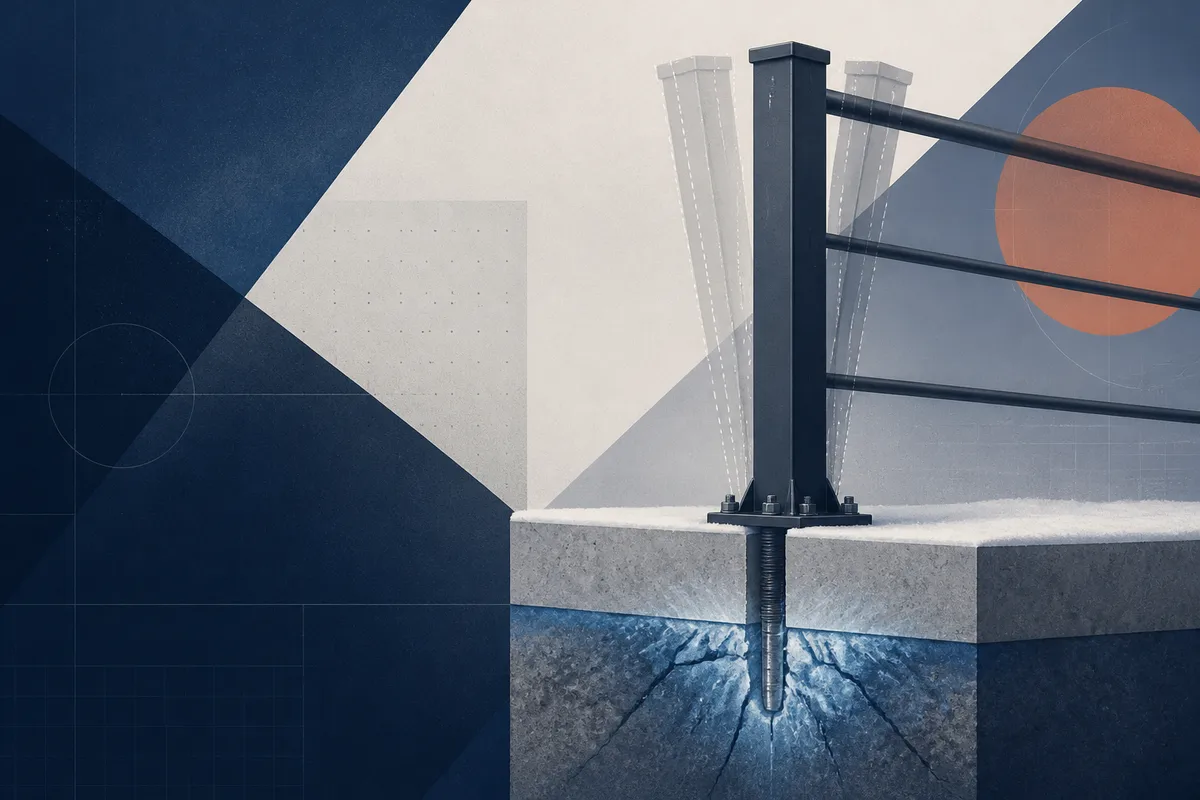
Homeowners often notice that a porch railing that felt rock-solid in October becomes dangerously unstable by March. This isn't a failure of the metal itself, but a predictable mechanical breakdown of the interface where the post meets the concrete step. When moisture infiltrates the gap between the post and the surrounding masonry, the subsequent expansion of ice acts as a hydraulic jack, widening the hole and shattering the grout bond.
This guide explains the physics of frost-driven railing failure and the specific technical requirements for a permanent repair. It is written for property managers and owners who need to move beyond temporary fixes and understand why traditional concrete patches fail in variable northern climates.
The mechanics of winter railing failure
A railing post wiggles because the "plug" of grout holding it in place has lost its lateral compression. In areas where temperatures frequently oscillate across the freezing point, several factors accelerate this degradation:
- Water enters the micro-fissures between the metal and the grout through capillary action.
- The transition from liquid to ice results in a volume increase, exerting immense outward pressure against the concrete sidewalls.
- Metal posts conduct cold deep into the concrete, causing the interior of the hole to freeze faster than the surrounding slab.
- Repeated freeze-thaw cycles turn small cracks into structural voids, eventually allowing the post to move freely within the hole.
- Road salt tracked onto porches lowers the freezing point of water, increasing the frequency of these expansion cycles within a single season.
The playbook for loose railing post in concrete repair
Restoring a wobbly railing requires more than pouring new material into a crack. According to decksdirect.com, a common culprit behind wobbly railings is deteriorated fasteners or connections that loosen over time due to natural elements. To achieve a bond that survives a northern winter, the repair must address the root cause of water ingress and material shrinkage.
1Remove failed material entirely
Surface-level patches are the primary cause of repeat failures because they do not address the void at the bottom of the post-hole. It is necessary to pinpoint exactly where the movement is coming from, such as the base of the post (sihandrails.com). A technician must chip out the old, fractured grout to a depth where the metal is still clean and the surrounding concrete is sound. Any remaining loose debris will prevent the new bonding agent from adhering to the substrate.
2Prepare the metal substrate
Rust acts as a bond-breaker. Once the hole is cleared, the section of the post that will be submerged must be cleaned of oxidized metal and old paint. If the metal has thinned significantly due to corrosion, the structural integrity of the post is compromised. Repair options may include welding in a new piece of metal or using longer concrete screws to stabilize the base (facebook.com).
3Select a non-shrink anchoring cement
Standard concrete shrinks slightly as it cures, creating a microscopic gap that immediately invites water back into the assembly. High-performance repairs utilize non-shrink grout or anchoring cements that expand slightly during the curing process. This expansion creates a "press-fit" tension that locks the post into the concrete slab.
4Create a shedding profile
The geometry of the finished repair determines its lifespan. Rather than leaving the grout flush with the porch surface, the material should be slightly crowned or beveled. This creates a pitch that directs water away from the post, preventing liquid from pooling at the most vulnerable point of the assembly.
The hydraulic pressure of ice expansion
The primary reason for railing post movement after winter is the immense force generated by confined ice. When water is trapped in a core-drilled hole, it has no room to expand upward if the surface has already frozen over. Over time, weather damage can weaken the structure and loosen connections (decks.com).
In older neighborhoods, many railings were set using lead or sulfur. Over decades, these materials can pull away from the concrete sidewalls. Modern repairs address these failures by using durable anchoring compounds that provide higher resistance to movement, allowing the assembly to withstand the vibrations of daily use without cracking the water seal. Loose deck railings are a noted winter safety risk in cold climates (bossdecks.com).
How Detroit Stair Railing helps
Professional railing remediation focuses on restoring the structural connection between the ironwork and the masonry. A typical scope of work involves evaluating the depth of the original post-setting and determining if the surrounding concrete slab is thick enough to support a new anchor. In cases where the concrete has spalled or cracked significantly, the repair may involve larger masonry stabilization. Property owners are generally responsible for maintaining safe passage on their premises, which includes ensuring the stability of guards and handrails attached to stairs. A sound repair involves cleaning the structural void, applying weather-resistant anchoring compounds, and ensuring the railing meets local height and load-bearing expectations. For properties in the Warren service area or surrounding suburbs, addressing these issues before the next deep freeze is critical to preventing total masonry failure.
Frequently asked questions
Can I fix a wobbly railing by just putting caulk around the base?
Caulk is a topical sealant and provides no structural support; it will not stop a post from wiggling. While it may temporarily keep water out, it cannot withstand the leverage forces applied to a handrail when someone leans on it. A structural repair requires removing the failed grout and replacing it with a high-strength anchoring material.
Why did my railing get loose only a year after it was installed?
Early failure is usually the result of using standard bagged concrete or mortar instead of a dedicated non-shrink anchoring cement. If the installer did not properly clean the hole of dust and slurry before pouring, the new material never actually bonded to the old concrete, allowing water to enter the gap almost immediately. Modern standards often require that posts sit inside the rim of the structure to ensure a secure connection (youtube.com).
Is a loose railing post in concrete repair possible if the concrete is cracked?
If the crack radiates outward from the post-hole to the edge of the step, the concrete itself may have lost its structural integrity. In these instances, simply resetting the post is insufficient because the "anchor" (the concrete) is broken. The crack must be stabilized or the section of the step rebuilt to ensure the railing can take a lateral load.
Does salt make my railing posts loosen faster?
Yes, salt accelerates the corrosion of the metal post at the ground line. As the iron rusts, it expands and flakes off, which creates a larger gap between the post and the concrete. Additionally, salt allows water to stay in a liquid state longer, increasing the number of times it can seep into cracks and refreeze as the temperature drops at night.
How deep should a railing post be set in the concrete to prevent wiggling?
The post must be embedded deep enough into sound concrete to resist lateral pressure. If the embedment is too shallow, the leverage from the top of the rail will easily snap the grout bond. For heavy wrought iron railings in a freezing climate, ensuring the post sits at a proper depth within the masonry provides better resistance against the forces of frost heave.
What happens when you get in touch: you describe the situation, the team asks the few questions that actually change the answer, and you get a clear scope and next step — no obligation.